
That time I ran into deep snow in the Dolomites
Crossing the high alpine passes of the Val Gardena after an unexpected snowfall, we discovered landscapes that words can barely capture.
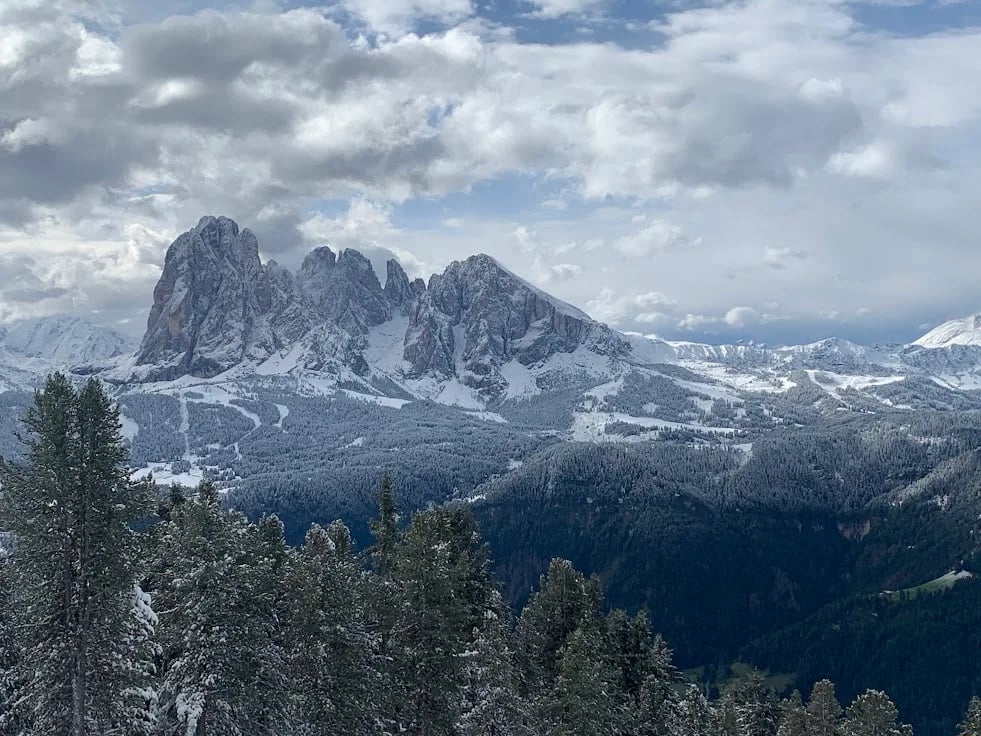
Early one morning, the mountains were enveloped by fog. I got up and walked out on the balcony and was immediately struck by a smell. Yes, a smell. Having grown up in the Alps, my body recognized immediately: the smell of winter, of snow. Next, my body shivered - the temperature was well below the freezing point. The fog dissipated and revealed a scenery that frankly shocked me: snow everywhere - on roads, on rooftops, in the forests. The peaks looked frozen solid. And white. The sky, grey as lead, did not promise anything good. It was only September 14th and I had come to the Dolomites to hike with a group. In 30 years of outdoor activities, I had never seen anything like this - not at that altitude, not in that time of the year.
We had arrived in the legendary Selva, Gardena Valley, the evening before. The area, one of the most iconic of the Dolomites, is a true alpine playground for hikers - when snow does not entirely cover it. The weather forecast, which I had been checking repeatedly - had predicted a cold spell with potential snow above 2200m in a context of below-average temperatures. Nothing unheard of for September in the Alps. So what everyone expected (present company included) was a smattering of snow above the tree line which would have lingered for a few days; and given the fact that our plan was to stay on trails which I knew to be well-kept, wide and groomed, nobody believed that this bad weather system would pose major problems. Rain had begun to fall on the evening of our arrival but we had all gone to sleep with a light heart: nobody could have imagined that what followed was going to make history in the local meteorological records.
But the forecast underestimated the storm. Snow descended - and accumulated - all the way down to 1200m (an enormous difference from the 2200m forecast - and in much larger quantities). I tried to draw from my personal experience and that told me that when snowfall occurs so far outside of winter (whether in late spring or very early autumn), it generally doesn’t last long on the ground at lower elevations. Not in the Alps, at least. Well, that was the first time I saw temperatures stay consistently below zero for several consecutive days at such a modest elevation (again: we were well below 2000m) in September. I had to rearrange all the hikes and adapt them for the newly formed conditions.
Making virtue out of necessity turned out to be an interesting challenge. I immediately ruled out one trail which was in no way safe to be hiked in that weather (in case you are curious: it’s trail number 525 from Forcella Sassolungo down to an amphitheater of towering peaks - a mind-blowing place) and made adjustments to the others. My main priority was obviously safety. The group was small and rather homogenous, but even minor differences become significant when snow and ice enter the equation. There was also the question of finding rewarding hikes: since most altitude trails were now inaccessible, we would have to hike at lower altitudes; such itineraries often unravel in forested areas with limited views and of marginal interest. There are, of course, exceptions, but you have to know them and find them. But nature itself came to my rescue: sceneries which would have been trivial just a few days before suddenly took on a wild, untamed appearance - an appearance of deep snow, wildness and ice. For the following three days we hiked in some of the most spectacular alpine scenery you can imagine.
Was it hard? Absolutely. Was it worth it? Undoubtedly. And because it was only the second week of September we got to witness some things that some may never see: flowers piercing through the snow, red-cap mushrooms jutting out of the white blanket. And it was quite something, too, to pick blueberries and lingonberries and taste them half frozen. And every now and then, the rocky, unreal silhouettes of the Dolomites would make their brief appearance through the clouds, towering above a subarctic landscape. It wasn’t always easy, obviously. On day 2, a relentless, almost brutal, wind from the north picked up and swept the mountains mercilessly. Walking in knee deep snow, the fierce gusts lashing our faces, a layer of clouds hiding even the minor heat the sunshine could have provided, was demanding. But it made it memorable.
Speaking to older locals I was told they had not seen anything like this since the 1980s and even then it had been a unique occurrence. On my last hike, as I descended into town under a light shower of snow-rain, I looked up and saw the ridges of the Sella Massif materialize for a brief moment before melting back into the clouds. How many times again will I be able to look at the frozen, snow-capped Dolomites on a September morning?